Prioritize honest light
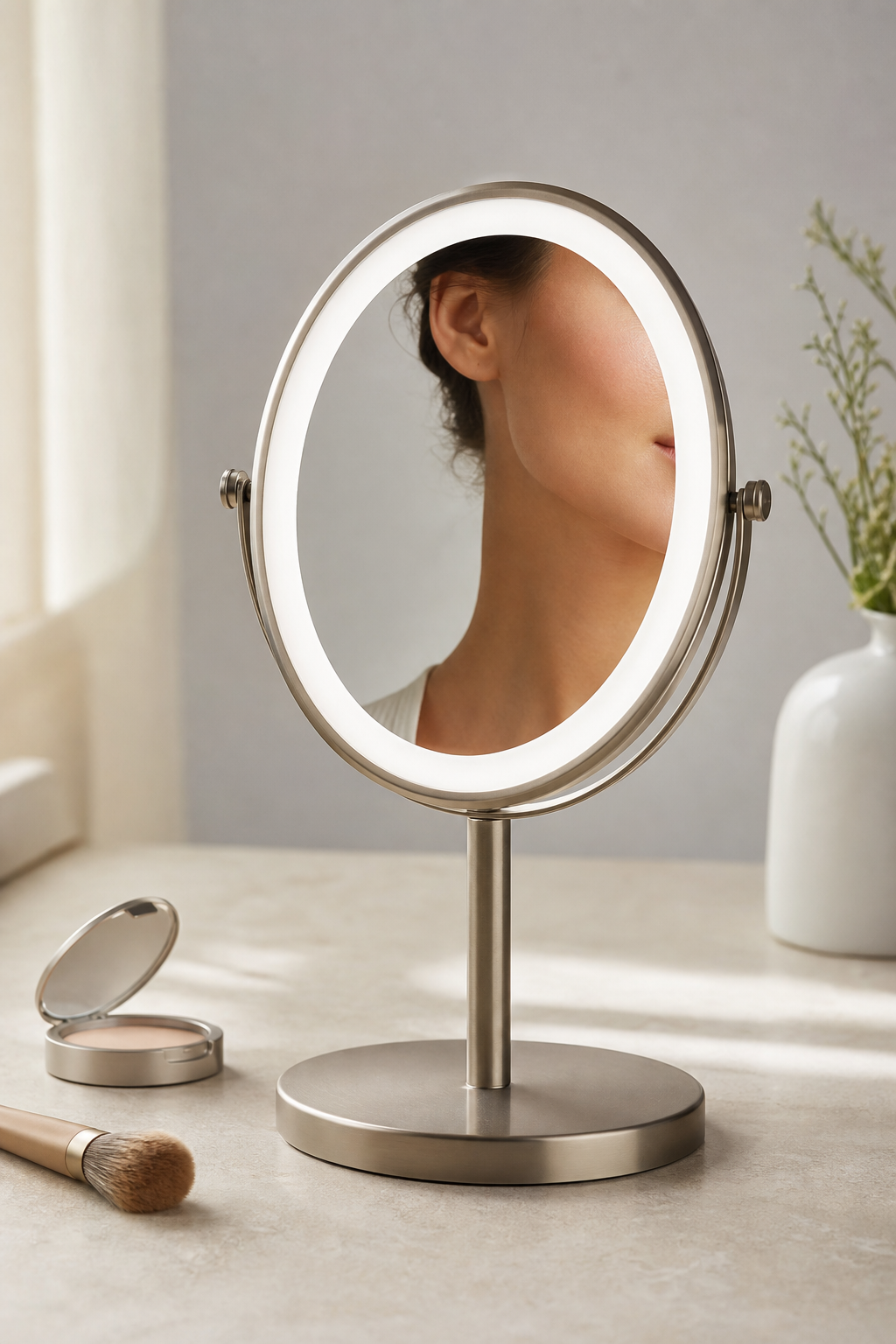
A makeup mirror should help you predict how color and texture will look beyond the vanity. Extremely cool light can encourage heavy application; very warm light can hide uneven blending. Look for a neutral daylight setting and smooth dimming rather than a long list of novelty modes.
Brightness should be adjustable without flicker or abrupt jumps. More light is not always better. The useful level illuminates the face evenly without forcing you to squint.
Choose magnification with restraint
A standard mirror handles most makeup. Moderate magnification helps with liner, brows, contact lenses, or precise grooming. Very high magnification narrows the field and can turn normal texture into an emergency. It belongs on a small reversible panel, not as the only view.
If you wear glasses, test the distance at which the mirror remains clear. An adjustable arm can be more valuable than another magnification level.
The base decides whether you keep it
Measure the vanity depth and the space beneath cabinets. A wide stable base resists tipping but consumes product space. Wall-mounted mirrors free the counter and require a confident installation. Folding models travel well but may wobble when fully extended.
Decide between rechargeable and corded power based on the outlet, not aesthetics. A rechargeable mirror should have a visible battery indicator and remain usable while charging if possible.
Buy the boring features
Choose even neutral light, continuous dimming, a stable base or arm, moderate optional magnification, and controls you can find by touch. Skip speakers, app controls, and decorative modes unless they solve a problem you already have.